Liberty Newswire 8/2/11

[The Liberty Insight Newswire is an aggregation of what we consider to be important financial and political news and commentary from across the web.]

This week’s special “Debt Ceiling Debacle” edition of the newswire features some excellent articles and clips to help explain the true nature of the debt ceiling Kabuki theatre debate and resolution. These articles may have a slightly different take than what you read and hear in the mainstream media. The media is shouting, “crisis averted!” and calling the resolution a victory for the Tea Party. (Oddly, I haven’t seen anyone from the Tea Party say it was a good deal.) They are touting the up to $2.4 Trillion in spending “cuts” without raising taxes. What a bunch of BS!

What did this deal actually accomplish? Here are a few points to keep in mind:

1. All of the spending “cuts” are not actually cuts, but reductions in the amount of increase in planned spending. The budget increases every year moving forward and will add $7 Trillion to the debt over ten years. Also, those cuts are budgeted over the next ten years with the bulk of the cuts happening further out into the future. For the first year, the only year that actually counts, the budget “cuts” total a whopping $21 Billion dollars. $21 Billion is less than one freaking percent of the yearly budget. Future congresses are not bound by the promise of this congress to cut anything.

2. The bill actually only specifies $900B in cuts and establishes a bi-partisan “Super Congress” of 12 members to hash out the remaining $1.5T in cuts. The bill they come up with cannot be amended by the “regular” members of Congress. How’s that for representation.

3. The Congressional budget assumes a growth rate of our economy of 4% this year. For the first half of this year, the annualized growth rate was actually less than 1%. In other words, they won’t be getting the revenue they expect and the deficit will actually be larger than expected. If the economy gets worse, the new budget ceiling might not even last through the 2012 election as Congress and the President hope.

So, to sum it up, all the deal accomplished was to push this country $2.4T deeper into debt in the next year and a half; while making zero structural changes to spending, taxation, and the fundamental problems facing our economy; and in the process admitting to our creditors that if we can’t borrow more money we will default on our debts; and creating a new extra-constitutional super Congress that further erodes our Constitution and rights.

Sweet deal! Now Congress can go enjoy their Summer break. Continue reading

Posted in Economy, Newswire, Politics | Tagged , , | Leave a comment

Liberty Newswire 7/25/2011

[The Liberty Insight Newswire is an aggregation of what we consider to be important financial and political news and commentary from across the web.]

This week’s newswire features more kicking the can down the road, the world’s largest hedge fund manager predicting a collapse of the dollar, congress just making shit up, and the “wonderful” job security of public employees. Continue reading

Posted in Newswire, Uncategorized | Tagged , | Leave a comment

An Investment for the Average Joe that Yields 16%, After Tax, Guaranteed, with Zero Risk!!!

Upon reading that title, your first instinct should be to run away as fast as possible. All investments have risk and nothing is guaranteed, especially a return that crushes the stock market. But please bear with me as I do a little explaining.

In my past articles about the state of the U.S. economy, I outlined why I believe that the United States is headed for a deep depression with a potential collapse of the U.S. dollar. The housing collapse, and ensuing recession wiped out the life savings of many people who had enjoyed upper-middle class lifestyles and good jobs before the recession. This 60 Minutes report shows just how fragile the financial situation of many Americans has become.

I believe the financial crisis of 2008 was just the warm-up. The next economic crisis will wipe out millions of Americans who are not prepared, but it will also create incredible investment opportunities for those with a strong financial foundation. But, regardless of whether you agree with my doomsday scenario or just think that the economy is in a “soft patch”, one thing is certain- There has never been a more important time to get your financial house in order than right now! Continue reading

Posted in Education, Investing | Tagged , , , , , , , , , , , , , , , , , , , , | 1 Comment

Liberty Newswire 6/29/11

[The Liberty Insight Newswire is an aggregation of what we consider to be important financial and political news and commentary from across the web.]

The articles in this weeks newswire show that “it’s worse than we think.” Whether it’s the fiscal future of the country, the deficit projections, stagnant incomes, the dollar’s status as the reserve currency, or the balance sheets of the international banking system, things may not be as good as we’re led to believe. Continue reading

Posted in Economy, Newswire | Leave a comment

Chart of the Week – Education Spending

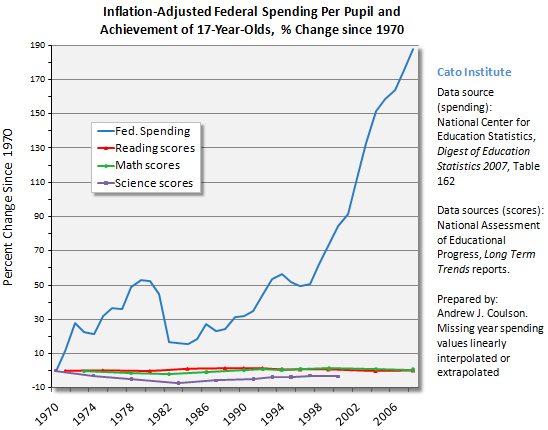
The chart below, from the Cato Institute, shows how massive increases in federal spending on education have done nothing to improve education results since 1970.

Should we be surprised?

When people discuss our public school system, the discussion usually hinges on how much more money the federal government should spend to improve education.

Instead, we should be asking a different question: “Why should the federal government be in charge of education at all?” Why should we take money from taxpayers in the various states, send it to Washington DC, use a good chunk of that money to pay bureaucrats to slap a bunch of stipulations, regulations and mandates on whatever remains, before sending it back to the states to fund their schools? And besides, unless my copy is missing a few pages, the Constitution provides no authority to the federal government to manage education. Continue reading

Posted in Chart of the Week, Education | Tagged , , , , | Leave a comment

New Liberty Insight Page About Money

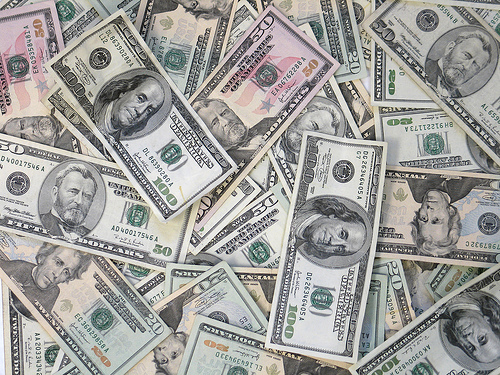
Photo by Tracy O at Flickr

What is money?

Money is one half of every transaction in our economy, yet most Americans don’t have a full understanding of what money is, where it comes from, and what gives it value. Even fewer people understand how our Federal Reserve banking system works. Fewer still even give a crap.

Why should I care?

Everyone seems to understand that our economy is not doing so well. But why? Over the past few decades we’ve had tremendous advances in technology and productive capacity, yet families are struggling with underwater mortgages, huge student loan debts, and high healthcare costs; even with two parents working in many cases. Something is clearly not working.

People attribute the struggling economy to a variety of causes- too much government spending, not enough government spending, taxes that are too high (or too low), greedy corporations, excessive regulation (or not enough regulation), etc. However, they rarely look to the root cause of it all- our monetary system.

Austrian economists understand that a sound and stable currency is the foundation of a strong economy. They understand that artificial control of interest rates distorts the market and creates booms and busts. They understand that money derived from debt is inherently unsustainable and eventually collapses. They understand that government guarantees and bailouts of banks and corporations encourages those banks to take excessive risks and repeat the same mistakes at the expense of the taxpayer.

This understanding allowed these economists to predict and explain the dot com bubble, the housing bubble, and the financial collapse. Today, these same economists are predicting that we are on the verge of a major collapse of our money itself.

So… If you don’t want to go broke, you should care about how our monetary system works.

Liberty Insight’s new “Money” page

Liberty Insight is dedicated to educating readers about sound money and ways to protect oneself in today’s extraordinary economic times. To that end, we have created a new page dedicated to explaining the basics of our monetary system and providing resources to help readers learn more.

We view this page as a jumping off point for learning about our monetary system. Please share the link with anyone you think would like to learn more about this topic.

To view the page, simply click on the “Money” link on the Liberty Insight banner at the top of this page or click here.

Posted in Economy | Tagged , , , , | Leave a comment

What if OPEC Nations Demanded Gold for Oil?

Why did we invade Libya? The official reason is that Gaddafi was murdering his own people so we had to stop him. Perhaps, but so are dictators in a number of other countries. Many skeptics of the official story believe that it may have something to do with securing our oil. The video below discusses a new wrinkle on that theory. According to the report, some observers believe that Gaddafi was promoting a plan to establish an African/Middle Eastern currency backed by gold and to only accept gold for their oil.

Trying to deduce the real reasons for invading Libya without insider knowledge is just conjecture. This idea is a little too conspiracy theory-y for my tastes. (I wouldn’t rule it out though.) But irrespective of the true reasons for invading Libya, the video brings up an interesting question:

What would happen if OPEC nations agreed to accept only gold for their oil? Continue reading

Posted in Economy, Foreign Policy | Tagged , , , , , , , , , | 2 Comments

State of the Economy- Spring 2011

[Authors note: This paper is not intended only for those who invest in the stock market or are interested in economics. It is intended for anyone who works for a paycheck, supports a family, or just cares about their future in general. If you know anyone like that please feel free to pass it on.  PDF version here.]

May 8, 2011

A few years ago I developed a weird, perverted interest in studying the nature of our Federal Reserve banking system, the history of money, and Austrian economic theory. The more I learned, the more astounded I became about how completely bizarre, unsustainable, and Machiavellian our monetary system is. And the more I studied the fundamentals of the U.S. economy, the more concerned I became that we were fast approaching and economic crisis that would dwarf the great depression.

Even after the near collapse of the entire banking system, none of the mainstream economists seemed to understand or even care about the root causes of the problem. The media was busy saying, “Crisis averted. Now back to Dancing with the Stars.” The very few who were warning about the serious flaws in our system were shouting into the wind. So, a year ago I was compelled to write a paper to warn my friends about the fundamental problems with the economy that no one seemed to be reporting. The paper was intended to be educational and was fairly matter-of-fact in tone. I was hoping to get my friends to take notice and look into ways to protect themselves from a steady dollar depreciation.

Six months later, as events continued to unfold as expected, I wrote a follow-up paper to outline some of the new developments and express more urgently how the actions our politicians and central bankers were taking were increasing the chances that the dollar would collapse. I was hoping it would spur people on to take some precautionary measures to protect themselves just in case things unfolded as I was suggesting. Those who did seem to be pleased with the 50% appreciation of their silver coins in the past six months.

Today, things are beginning to unfold fast and furious and there are some big events on the horizon that I want to warn you about just in case they don’t mention it on the evening news. The purpose of this paper is to:

  1. Scare the shit out of you so you take action.
  2. Entice you with the greatest financial opportunity in the history of the world so you take action.

Since I’m going for the shock and awe (no relation to Dessert Storm) I’m going to mix things up a bit and start with the conclusion. Then I’ll back track and show you how I got there. Continue reading

Posted in Economy, Investing | Tagged , , , , , , , , , , , , , , , , , , , , , | Leave a comment

What Does a Libertarian City Look Like?

Most people just assume that certain public functions such as building roads, managing parks and collecting trash need to be handled by the government.  Libertarians believe that private companies competing for business are more efficient and cost effective than government can ever be. The excellent short video below, produced by Reason.tv, shows what can happen when a city eschews public bureaucracies, public unions and defined benefit plans, in favor of lean government and private, free-market solutions.

I’d be curious to find out more about how they run their school system. If they have a voucher system with competing schools I’m all in.

Posted in Community | Tagged , , , | 2 Comments

Chart(s) of the Week – Incarceration Rates

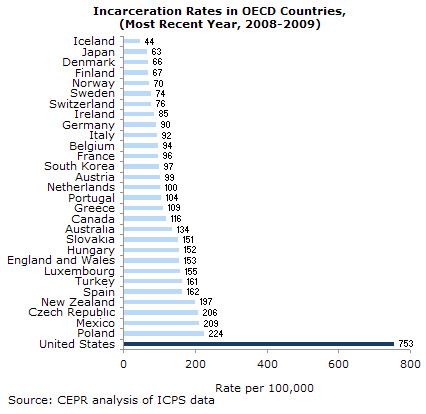
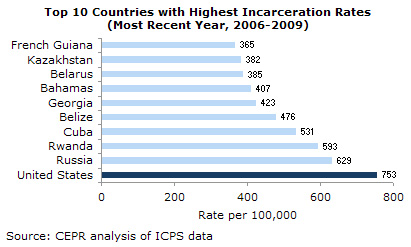
Land of the Free? America was founded on freedom, liberty and justice. So why is it that we lock up more of our citizens per capita than any other county in the world? Are Americans just inherently criminals? Australia was founded as a penal colony and they have less than a fifth of the prisoners we have per capita.

Chart 1

The chart to the left shows the incarceration rates for OECD countries (i.e. countries like us). You almost miss the dark blue line at the bottom which shows that America locks up over three times as many people as the next biggest offender (pun intended). Is it that our prosecutors are eight times better at convicting criminals than their German counterparts?

Chart 2

I think this chart is even scarier. I thought for sure that communist countries and dictatorships would lock up way more of their people than us. Of course, this assumes we can trust the numbers from Cuba and Rwanda.

Chart 3

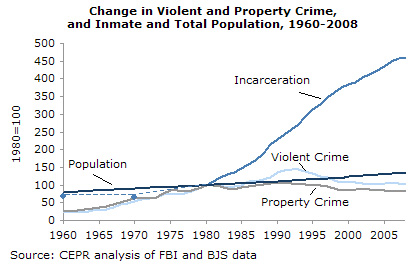
The third chart shows that our incarceration rate began turning up in 1970 and again around 1980 while violent crime and property crime stayed roughly in line with population growth. The purpose of this post is not to explain why we lock up so many people, but just to point out the irony in how casual we are about taking people’s freedom away…

But while we’re here, maybe I can postulate one possible reason why so many Americans are in jail instead of being productive members of society. In 1971 President Nixon declared “War on Drugs.” Then in 1984 Congress passed the Sentencing Reform Act which decreased the amount of discretion Judges had in sentencing and shifted priorities from reform towards punishment. As a result, non-violent drug offenders faced minimum sentences and were introduced into the prison cycle. Since then, millions of Americans have been locked up and saddled with a criminal record for an activity that our last three Presidents have all admitted to partaking in.

Drug abuse is a very serious problem; but is it a criminal problem or a medical problem? We treat alcoholism as a medical problem. Is alcohol really that much different? It’s an addictive chemical that alters our behavior and, when abused, has harmful affects on our health. Same with cigarettes and we’ve reduced the rate of smoking through health risk awareness, social pressure, laws against smoking in public places (which I personally think are BS when it comes to private establishments but that’s a different subject) and treatment programs.

In the 1920s we treated alcohol consumption as a crime and it spawned organized crime. The drug gangs of today are no different than the gangsters of the 1920s. Making drugs illegal drives up the price of drugs which incentivizes sellers to enter the market, push their product on potential customers (especially kids), and battle over territory. Since they can’t get protection from the police, they are forced to arm themselves. Addicts are often forced to resort to robbery to pay the excessively high costs of their habit. No one knocks off a liquor store for a pack of Marlboros.

In 2001, Portugal “decriminalized” all drugs including cocaine, heroin and methamphetamine, and instead of prison sentences, offered treatment to people caught possessing drugs. Far from becoming the haven for “drug tourists” as critics predicted, drug use among teens actually dropped and drug related pathologies such as AIDS and drug-use deaths dropped significantly. Maybe if we rethought our drug policy, we could lower our incarceration rate by 84% to match Portugal’s rate here in the land of the free.

Posted in Chart of the Week | Tagged , , , , , , , , , , | 3 Comments